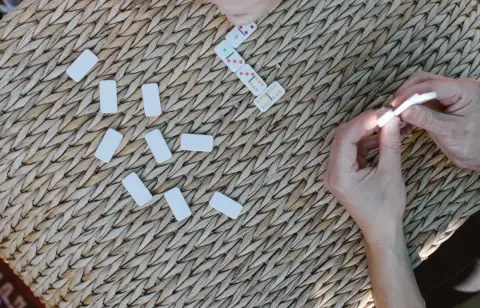
Domino math
Domino Hand Odds
Seven tiles out of 28. How many hands are there, how often do you get no double, and where is the tile you are missing? The answers are plain arithmetic.
4 min read
Published October 15, 2026
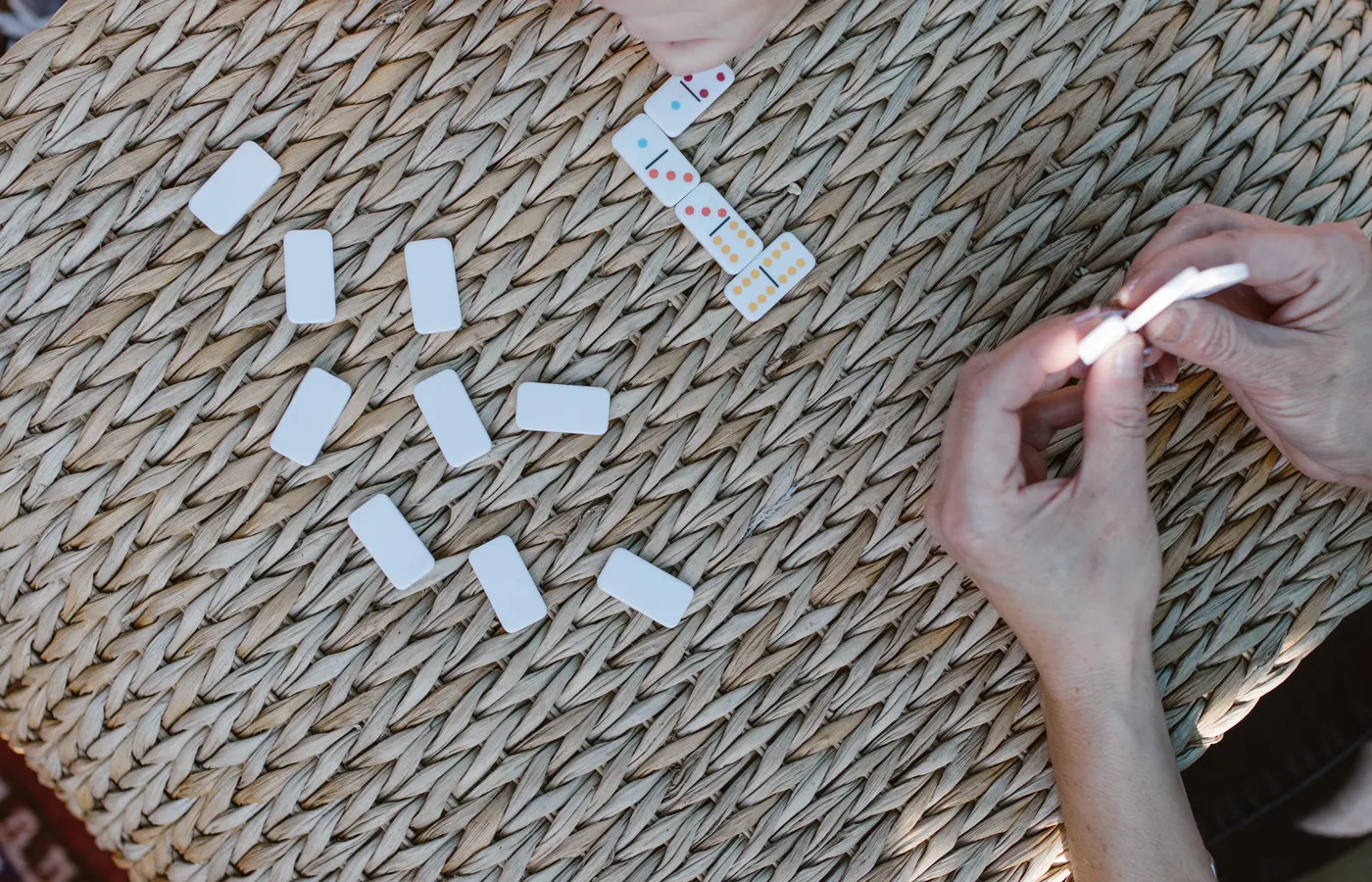
Quick answer
What are the odds in a double-six domino hand?
With four players each holding 7 of the 28 tiles, any given tile is in your hand 25% of the time. There are 1,184,040 possible hands; 9.8% of them have no double, and a hand holds 1.75 doubles and 42 pips on average.
Jump to a section
Four players, 28 tiles, seven each. That simple deal hides a few numbers worth knowing. This page works them out step by step, using only counting. It does not tell you how likely you are to win a hand; that depends on how everyone plays.
01.
Start with the set
A double-six set has 28 tiles: the 21 combinations of two dice plus 7 tiles with a blank side. With four players, each takes 7 tiles, so all 28 are dealt and nothing is left over.
Each number from blank to six appears on 7 tiles. Take the fives: 5-0, 5-1, 5-2, 5-3, 5-4, 5-5 and 5-6. Counted as pips, that is 8 appearances, because the double 5-5 shows the five twice. Pagat's Caribbean dominoes page puts it the same way: eight occurrences of each number.
FichaFlow deals this full 28-tile set, seven tiles to each of the four players.
02.
Where is a given tile?
Before you look at your hand, any one tile is equally likely to be with any of the four players. You hold 7 of the 28, so the chance it is yours is 7/28 = 1/4, or 25%.
Once you see that it is not in your hand, 21 tiles are left with the other three players, 7 each. So the tile is with your partner 7 times in 21, which is 1 in 3, and with one of the two rivals 2 times in 3.
03.
How many hands are possible?
The number of ways to choose 7 tiles from 28, when order does not matter, is written C(28,7). Multiply 28 × 27 × 26 × 25 × 24 × 23 × 22 and divide by 7 × 6 × 5 × 4 × 3 × 2 × 1 = 5,040.
The result is 1,184,040 possible hands. Each one is as likely as any other on a fair deal.
04.
How often you get no double
The set has 7 doubles and 21 other tiles. A hand with no double is 7 tiles chosen only from those 21: C(21,7) = 116,280 hands.
Divide by all hands: 116,280 / 1,184,040 = 0.098. So about 9.8% of hands, roughly one in ten, have no double at all.
For the average, each of the 7 doubles has a 7/28 chance of being yours. Add them up: 7 × 7/28 = 1.75 doubles per hand.
05.
How many pips you hold
Each number appears 8 times in pips, so the whole set holds 8 × (0 + 1 + 2 + 3 + 4 + 5 + 6) = 8 × 21 = 168 pips. Split among four hands, the average hand holds 168 / 4 = 42 pips.
A hand above 42 is heavier than average, and a hand below it lighter. That is all the number says; it is not a prediction of who wins.
06.
What players do with it
The math tells you what is likely before play starts. Strategy is a separate question, and the sources we use describe it, they do not prove it. Pagat's partnership dominoes page advises leading your strongest suit, ideally with a double, keeping that suit on the ends, and reading your partner's lead as their strongest suit.
Bring this to the table
→
Each number appears on 7 tiles, and 8 times in pips because its double shows it twice.
→
Any given tile is yours 7 times in 28, or 25%. If it is not yours, it is your partner's 1 time in 3.
→
There are 1,184,040 different 7-tile hands; 9.8% of them have no double.
→
On average a hand has 1.75 doubles and 42 of the set's 168 pips.
Questions from the table
How many different domino hands are there?
With a double-six set and 7 tiles per hand, there are C(28,7) = 1,184,040 possible hands.
What is the chance of getting no double?
About 9.8%. There are 116,280 hands with no double out of 1,184,040, roughly one hand in ten.
If I do not have a tile, who has it?
Each of the other three players holds 7 of the remaining 21 tiles, so your partner has it 1 time in 3 and a rival 2 times in 3.
Do these numbers tell me my chance of winning?
No. They describe the deal. Who wins a hand depends on how the four players play it.
Where this comes from
Want to check the details? These are the references we used.
- Dominoes
University of Tulsa · Accessed October 15, 2026
Explains the 28 tiles of a double-six set as the 21 combinations of two dice plus 7 tiles with a blank.
- Caribbean Dominoes (John McLeod)
Pagat · Accessed October 15, 2026
States that each number has eight occurrences in a double-six set, the double counting twice.
- Partnership Dominoes (John McLeod)
Pagat · Accessed October 15, 2026
Four players with 7 tiles each, and the strategy advice to lead your strongest suit and read your partner's lead.