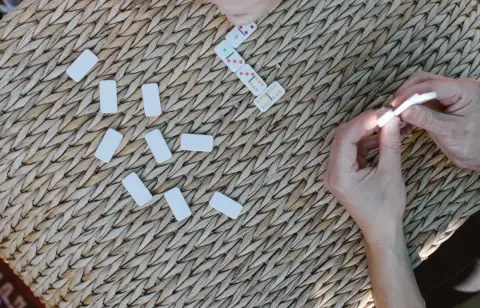
Know your Fichas
Why Double-Six Has 28 Fichas
A double-six set contains every unordered pairing from blank through six exactly once. That one rule produces 28 unique Fichas.
3 min read
Published June 12, 2026
Updated October 15, 2026
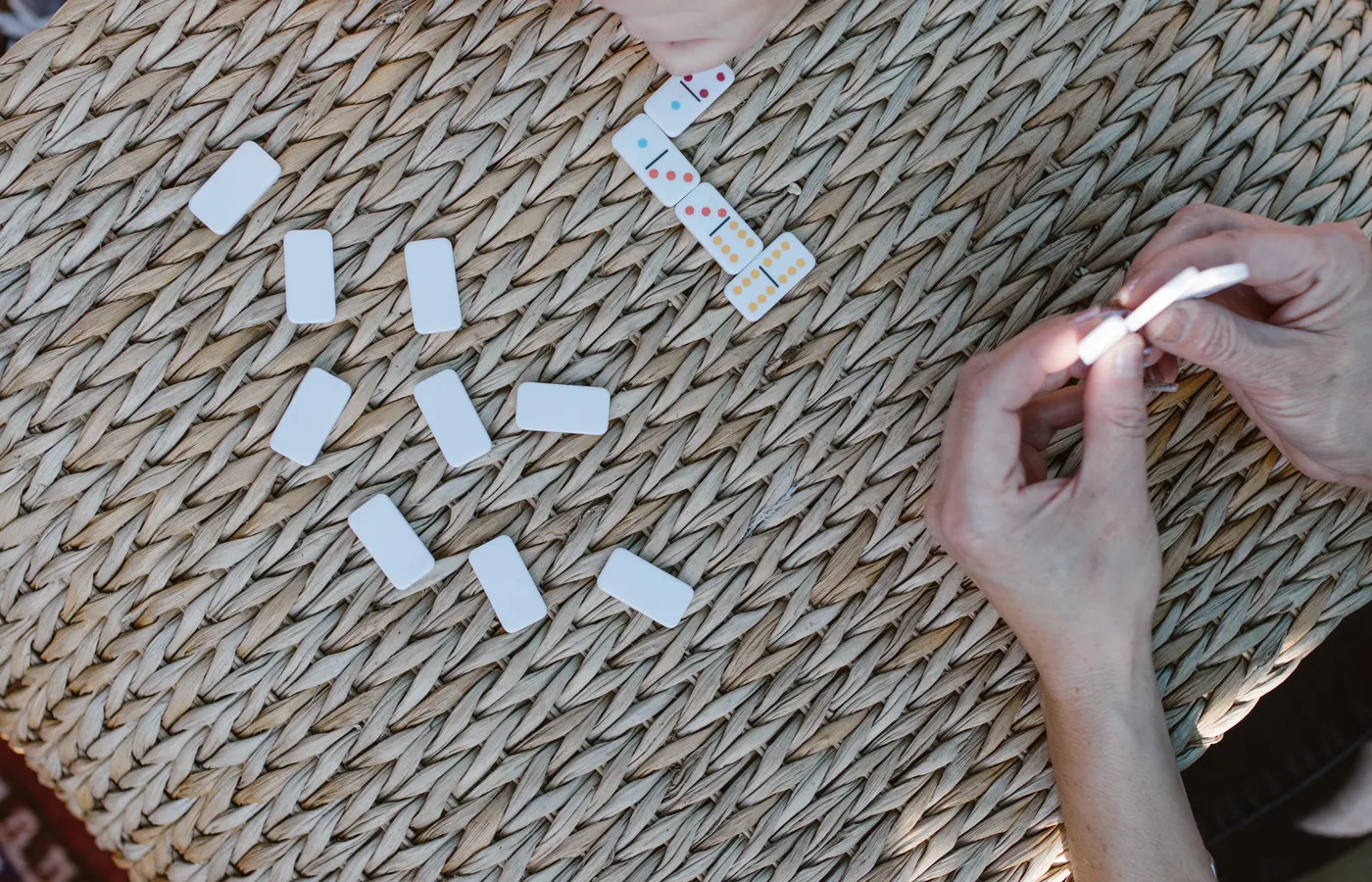
Quick answer
Why exactly 28 fichas?
There are seven possible ends—blank, one, two, three, four, five, and six—and the set includes each unordered pair once. Counting 7 + 6 + 5 + 4 + 3 + 2 + 1 gives 28.
Jump to a section
Understanding the set makes tile counting less mysterious. Every Ficha belongs to two numerical suits unless it is a double, and every value from blank through six appears on seven tiles.
01.
The count from seven possibilities to 28 fichas
Start with the seven possible values on one half: 0 through 6. Blank can pair with all seven values, including blank. One then adds six new pairs, because blank-one already exists. Continue with five new pairs for two, then four, three, two, and one.
The sum is 7 + 6 + 5 + 4 + 3 + 2 + 1 = 28. The general pairing formula is x(x + 1) / 2, where x is the number of possible end values: 7 × 8 / 2 = 28. The University of Tulsa puts it another way: the 21 combinations of two dice plus seven tiles with a blank. The same count gives 55 tiles for a double-nine set and 91 for a double-twelve.
02.
Seven suits, seven doubles, and 168 pips
Each value appears on seven Fichas. The six suit, for example, runs from blank-six through six-six. The seven doubles are blank-blank, one-one, and so on through six-six.
The 28 tiles hold 168 pips in total. Each value appears on seven tiles, and the double shows it twice, so each number appears eight times: 8 × (0 + 1 + 2 + 3 + 4 + 5 + 6) = 8 × 21 = 168.
03.
Why four players leave no boneyard
Dominican tables deal seven Fichas to each of the four players, as the linguist Roberto Guzmán writes in Acento. Four hands of seven account for all 28, so nothing remains face down to draw.
That complete deal is strategically important: every Ficha is either in a player's hand or eventually visible on the table. Passes and played suits therefore give information that a draw game does not provide in the same way.
Bring this to the table
→
A double-six set contains 28 unique Fichas and 168 pips in total.
→
Each value from blank through six appears on seven different Fichas.
→
Four players taking seven Fichas each use the entire set, leaving no boneyard.
Questions from the table
How many doubles are in a double-six set?
Seven: one for every value from blank-blank through six-six.
How many times does each number appear?
Each value from blank through six appears on seven Fichas.
Where this comes from
Want to check the details? These are the references we used.
- Dominoes
University of Tulsa · Accessed October 15, 2026
Supports the 28 tiles as the 21 two-dice combinations plus seven blank tiles, and the 55 and 91 tiles of double-nine and double-twelve sets.
- Caribbean Dominoes
Pagat · Accessed October 15, 2026
Supports the eight occurrences of each number in a double-six set, which gives the 168-pip total.
- Dominó (De palabra en palabra), by Roberto Guzmán
Acento · Accessed October 15, 2026
Linguist Roberto Guzmán: Dominican players use the double-six set and each of the four players takes seven tiles.