How to Play Dominoes, Step by Step
You don't need to know anything yet. Here is a whole game of dominoes, the Dominican way, one step at a time.
Doña Milagros says
Dominoes in one answer
Four players in two pairs share the 28 tiles, seven each. On your turn you lay a tile whose number matches an open end of the line; if nothing fits, you pass. The first to play their last tile wins the hand, and their pair scores the points left in the losers' hands.
Dominoes looks intense from the outside, with the slams, the trash talk and the counting. The rules underneath are short. This guide walks one full game the way it is played across the Dominican Republic, so you can sit down at a table, or a screen, and not get lost.
Step 1: The tiles and the table
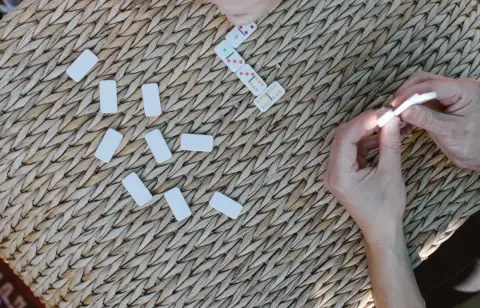
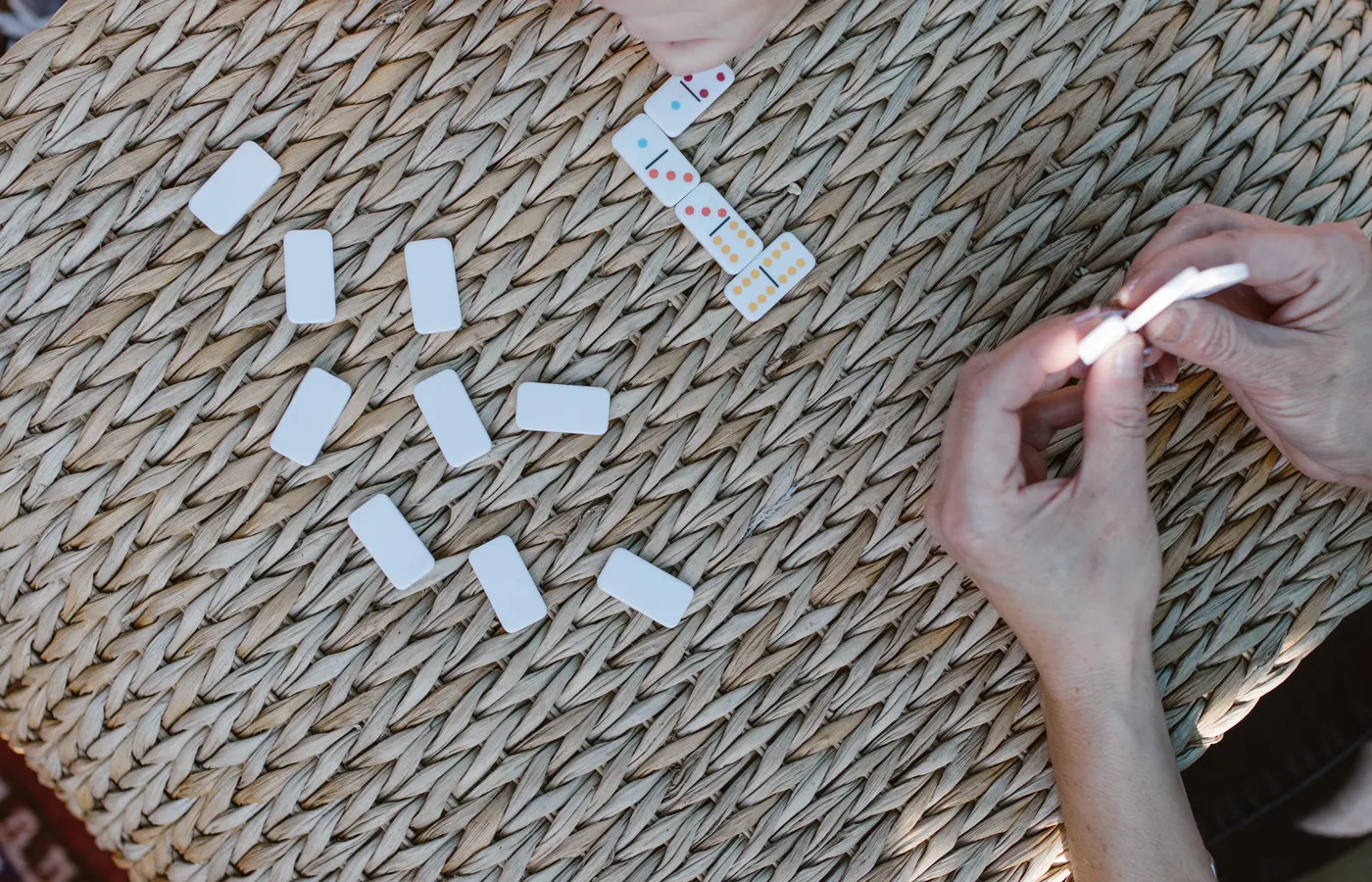
A standard set is the double six: 28 tiles, called fichas. Each tile has two halves with zero to six pips, and every pairing appears exactly once, from the 0-0 to the 6-6. Each number shows up on seven tiles.
The Dominican game is played by four people in two pairs. You sit across from your partner, who Dominicans call your frente, so turns alternate between the two teams.
—
28 tiles, numbers 0 to 6.
—
Tiles with the same number on both halves (1-1, 6-6) are doubles.
—
Your partner sits across from you, not beside you.
Step 2: Shuffle, take seven, and open
Turn every tile face down and mix them on the table. Each player takes seven and stands them up so only they can see the faces. Four players times seven is 28, so the whole set is in play and there is nothing left to draw.
At many tables the player holding the 6-6 opens the first hand by laying it in the middle. Whoever lays the first tile is the mano. In later hands, many tables let the winner of the last hand open, but this changes from table to table, so ask before you start.
—
Keep your tiles hidden from everyone, your partner included.
—
First hand: usually the 6-6 opens.
—
Later hands: often the last winner opens. Ask how your table does it.
Step 3: Your turn - match an end or pass
Play goes around the table. The line of tiles always has two open ends. On your turn, lay one tile whose number matches either end: if the ends show a 6 and a 3, you can play any tile with a 6 or a 3, touching the matching half.
If none of your tiles fit, you pass and the turn moves to the next player. Never pass while you hold a tile that fits. Dominican tables call that 'pasar con ficha' and punish it.
A double has the same number on both halves, so playing one doesn't change that end: a 6-6 on a 6 still leaves a 6 open.
—
One tile per turn, touching a matching end.
—
No match: pass. You don't draw when four people play.
—
Passing with a tile that fits is a foul.
Step 4: How a hand ends
A hand ends in one of two ways. Most often a player lays their last tile, the 'domino', and their pair wins the hand.
Sometimes nobody can play: every tile that would fit is already on the table or stuck in hands that can't use it. That is a tranque, a blocked game. The tiles are counted and the side with fewer points wins. How the count is done changes by table; our tranque guide explains the common Dominican way.
—
Out of tiles first: your pair wins the hand.
—
Blocked game (tranque): fewer points wins.
Step 5: Counting points and winning the game
In the common Dominican count, only the losers' tiles count: add every pip left in the losing pair's hands, and the winners write that number down. The total goes on the score until one pair reaches the target.
Dominicans usually play to 100, and some tables go to 200, so agree on the number first. Many tables also pay a bonus for special finishes, such as the capicúa, worth 25 or 30 depending on the table.
—
Score = the pips in the losers' hands.
—
Game = first pair to 100 or 200, depending on the table.
—
Bonuses like the capicúa are extra and vary by table.
Step 6: Your first game
Our tip: don't try to memorize strategy before your first hand. Play a few hands against bots, which wait for you and never laugh at a wrong tile. Once matching and passing feel automatic, start watching your partner: every tile they play and every pass tells you something.
When you're ready for people, play with friends online or ask to join a real table. The beginner strategy guide covers the first habits worth building.
—
Start against bots to learn the flow.
—
Then watch what your partner plays and passes on.
—
Ask the table's rules before the first tile goes down.
Bring this to the table
→
A double-six set has 28 tiles; with four players everyone holds seven and no tiles are left over.
→
On your turn, match an open end or pass. Passing while you hold a tile that fits is a foul.
→
A hand ends when someone plays their last tile or nobody can move (a tranque).
→
The winning pair scores the losers' tiles, and the game goes to 100 or 200, depending on the table.
Questions from the table
How many tiles does each player get?
Seven. A double-six set has 28 tiles, so four players take the whole set and there is nothing left to draw.
What happens if I can't play?
You pass, and the next player takes their turn. With four players you don't draw. Passing while you hold a tile that fits is a foul at Dominican tables.
Can two people play?
Yes. According to Wikipedia's section on Dominican domino, in one-on-one games players draw from the tiles left over, because only 14 of the 28 are dealt.
How many points win a game?
Usually 100 in the Dominican Republic, and some tables play to 200. Agree on the target before the first hand.
Where this comes from
Want to check the details? These are the references we used.
- Dominoes
University of Tulsa · Accessed October 29, 2026
Tile counts: the double-six set has 28 tiles and the double-nine set 55.
- Dominó (De palabra en palabra), by Roberto Guzmán
Acento · Accessed October 29, 2026
Seven tiles each, partners facing each other as frente, the mano opens, you pass when nothing fits, only the losers' tiles count, and Dominicans count to 100.
- Partnership Dominoes
Pagat · Accessed October 29, 2026
The partnership line game: four players in two pairs, matching an open end, passing when you cannot play.
- Dominó (Dominó de República Dominicana)
Wikipedia en español · Accessed October 29, 2026
Games to 100 or 200, the double six opens the first hand, passing with a tile is punished, and one-on-one games draw from the pile.
- A Return to the Domino Table
The Bronx Journal · Accessed October 29, 2026
Washington Heights tables: the double six opens the first hand and games usually go to 200.

Shall we try it at the table?