Culture & community
Dominican Domino in the Diaspora
Dominicans left in large numbers after 1961, and above all after 1965. In Washington Heights they set up domino tables on sidewalks and in parks, and founded a club around the game in 1966.
5 min read
Published March 20, 2026
Updated October 15, 2026
Quick answer
How did domino spread in Dominican diaspora communities?
Dominicans emigrated in large numbers after Trujillo's assassination in 1961 and especially after the 1965 US intervention (Migration Policy Institute). Washington Heights became their historic center, and there domino is played on the sidewalks and in the parks. Domino-loving friends formed a club there that was incorporated in 1966, today the Club Deportivo Dominicano.
Jump to a section
The table does not stay on one island. Washington Heights is where Dominican domino in the United States is best documented: in the parks, on the sidewalk, outside a bodega, and in a club that friends who loved the game founded in the 1960s.
01.
Where Dominican Americans live
About 1.3 million Dominican immigrants lived in the United States in 2018-22, the second-largest Caribbean immigrant group after Cubans (Migration Policy Institute). Counting everyone of Dominican origin, Pew Research Center put the figure at 2.4 million in 2021.
About a third of all US Dominicans live in New York City (CUNY Dominican Studies Institute). Up to the early 2000s Manhattan, above all Washington Heights and Inwood, held the most; in 2020 the Bronx had 343,403 Dominicans and Manhattan 174,214. After New York City, the largest communities in 2020 were Paterson (43,068), Boston (39,993), Providence (38,818) and Lawrence (34,352).
—
1.3 million Dominican immigrants (MPI, 2018-22); 2.4 million of Dominican origin (Pew, 2021).
—
New York City: about a third of US Dominicans; Bronx 343,403, Manhattan 174,214 (2020).
—
Next: Paterson, Boston, Providence, Lawrence (CUNY DSI, 2020).
02.
Why Dominicans left
Trujillo restricted emigration. The unrest that followed his assassination in 1961, and especially the US military intervention in 1965, led to mass emigration, according to the Migration Policy Institute. A second large wave began in the 1980s.
Historically most of them settled in New York City, in neighborhoods such as Washington Heights (MPI).
—
1961: Trujillo is assassinated; emigration grows.
—
1965: the US intervention brings mass emigration.
—
1980s: another large wave of arrivals.
03.
The tables in Washington Heights
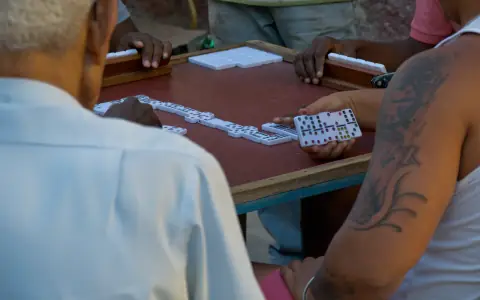
From the mid-1960s, Dominican immigrants came to define Washington Heights, and games of dominoes dotted the neighborhood, both east and west of Broadway (Leo Baeck Institute). When the weather allows, people play domino in the parks or on the sidewalk (amNY, 2018).
The Bronx Journal found tables in Highbridge Park and the Raoul Wallenberg Playground. Latino Rebels described older Dominicans meeting at a sidewalk table outside a bodega on Audubon Avenue.
—
Sidewalks and parks, when the weather allows (amNY).
—
Highbridge Park and Raoul Wallenberg Playground (The Bronx Journal).
—
A sidewalk table outside a bodega on Audubon Avenue (Latino Rebels).
04.
A club born from domino
The CUNY Dominican Studies Institute tells how, in 1966, 31 young Dominicans met in co-founder Conrado Guzmán's Washington Heights apartment to found the Club Deportivo Dominicano, a club born from nostalgia and a love of dominoes.
A New York State Senate resolution adds that a group of friends who loved domino decided in the summer of 1964 to form a social club to play dominoes and other games, and that it was incorporated on 23 March 1966 as the Dominican Sports Club, to keep their cultural roots.
—
Summer 1964: the decision to form a domino club.
—
23 March 1966: incorporated as the Dominican Sports Club.
—
Today: the Club Deportivo Dominicano.
05.
Rules change from table to table
No source we found compares New York tables with tables on the island. What the sources show is that rules change from table to table everywhere. One Washington Heights group told The Bronx Journal its games usually go up to 200 and a capicúa adds 25; the linguist Roberto Guzmán writes in Acento that Dominicans count to 100.
FichaFlow starts capicúa, pase de salida and pase redondo (o corrido) at 25. At the table they pay 25 or 30, depending on the table. Chuchazo is a Puerto Rican finish and pollona a Cuban word; both start at 0 in FichaFlow.
—
Target: 100, or 200, depending on the table.
—
Bonuses: 25 or 30, depending on the table.
—
Confirm the house rules before you sit down.
Bring this to the table
→
About 1.3 million Dominican immigrants live in the US, and 2.4 million people of Dominican origin.
→
Mass emigration followed Trujillo's 1961 assassination and especially the 1965 US intervention.
→
About a third of US Dominicans live in New York City; today the Bronx has the most.
→
In Washington Heights, domino is played on sidewalks and in parks, and a domino club dates to 1966.
Questions from the table
Where do most Dominican-Americans live in the United States?
About a third live in New York City. Washington Heights and Inwood were the first center; in 2020 the Bronx had the most Dominicans. After New York City come Paterson, Boston, Providence and Lawrence (CUNY Dominican Studies Institute).
Did domino rules change in the Dominican diaspora?
No source we found compares New York and island tables. Target, bonuses and who opens change from table to table in both places, so confirm the house rules before playing.
Why is domino so important to Dominican culture?
In the Dominican Republic domino is the unofficial national pastime (El Día). In Washington Heights, a club was born from nostalgia and a love of dominoes (CUNY Dominican Studies Institute), and its founders formed it to keep their cultural roots (New York State Senate).
Where this comes from
Want to check the details? These are the references we used.
- Dominó (Roberto Guzmán, De palabra en palabra)
Acento · Accessed October 15, 2026
Linguist Roberto Guzmán: Dominican players count to 100.
- Así se viven los domingos a lo dominicano
El Día · Accessed October 15, 2026
Domino as the unofficial national pastime of the Dominican Republic.
- A Return to the Domino Table
The Bronx Journal · Accessed October 15, 2026
Washington Heights tables in Highbridge Park and Raoul Wallenberg Playground; games to 200, capicúa +25.
- Dominó (Dominó de República Dominicana)
Wikipedia en español · Accessed October 15, 2026
Bonus values of 25 or 30, depending on the table.
- Cómo jugar al Dominó - Reglas del Dominó
Dominó: arte o ciencia · Accessed October 15, 2026
Capicúa, pase de salida and pase redondo (o corrido), normally 25.
- pollona
ASALE · Accessed October 15, 2026
Diccionario de americanismos marks pollona as a Cuban domino word.
- Club Deportivo Dominicano
CUNY Dominican Studies Institute · Accessed October 15, 2026
1966, 31 young Dominicans in Conrado Guzmán's apartment; born from nostalgia and a love of dominoes.
- Reglas del dominó boricua
mesa28 · Accessed October 15, 2026
Puerto Rican rules where the chuchazo is a finish on the double blank.
- Resolution J3624 (2016), Dominican Sports Club
New York State Senate · Accessed October 15, 2026
Domino game lovers; decision in summer 1964; incorporated 23 March 1966 to keep cultural roots.
- Immigrants from the Dominican Republic in the United States
Migration Policy Institute · Accessed October 15, 2026
1.3 million immigrants (2018-22); emigration after 1961 and especially 1965; Washington Heights.
- Facts on Hispanics of Dominican origin in the United States, 2021
Pew Research Center · Accessed October 15, 2026
About 2.4 million Hispanics of Dominican origin in the United States in 2021.
- Dominicans in the United States: A Socioeconomic Profile, 2022
CUNY Dominican Studies Institute · Accessed October 15, 2026
A third of US Dominicans in New York City; Bronx and Manhattan counts; Paterson, Boston, Providence, Lawrence.
- 'Little Dominican Republic' preserves culture in Manhattan
amNY · Accessed October 15, 2026
Washington Heights: domino in the parks and on the sidewalk when the weather allows.
- 'Paciencia y Fe': Hard Times at the Real Bodega of 'In the Heights'
Latino Rebels · Accessed October 15, 2026
Older Dominicans playing domino at a sidewalk table outside a bodega on Audubon Avenue.
- A Changing Neighborhood (Refuge in the Heights)
Leo Baeck Institute · Accessed October 15, 2026
From the mid-1960s Dominicans defined Washington Heights; domino games across the neighborhood.